
Why Doctors Are Misdiagnosing Perimenopause as Thyroid Disease — And What to Ask For Instead
Fatigue, brain fog, weight gain, and hair thinning belong to both conditions. New testing protocols are finally untangling which is which.

She was 44, exhausted, and 18 pounds heavier than the year before. Three doctors had told her it was her thyroid. Two more said it was 'just stress.' What it actually was, her sixth doctor finally diagnosed, was textbook perimenopause — with a thyroid that looked sluggish only because her estrogen was crashing.
Her story isn't unusual. In a 2024 audit of nearly 4,000 charts at a large women's health network, almost half of women started on thyroid medication between ages 40 and 52 were later found to have normal thyroid function. The thyroid wasn't the problem. Estrogen was — and a single blood draw, ordered at the right point in the cycle, would have made it obvious.
Why the Two Conditions Look Identical
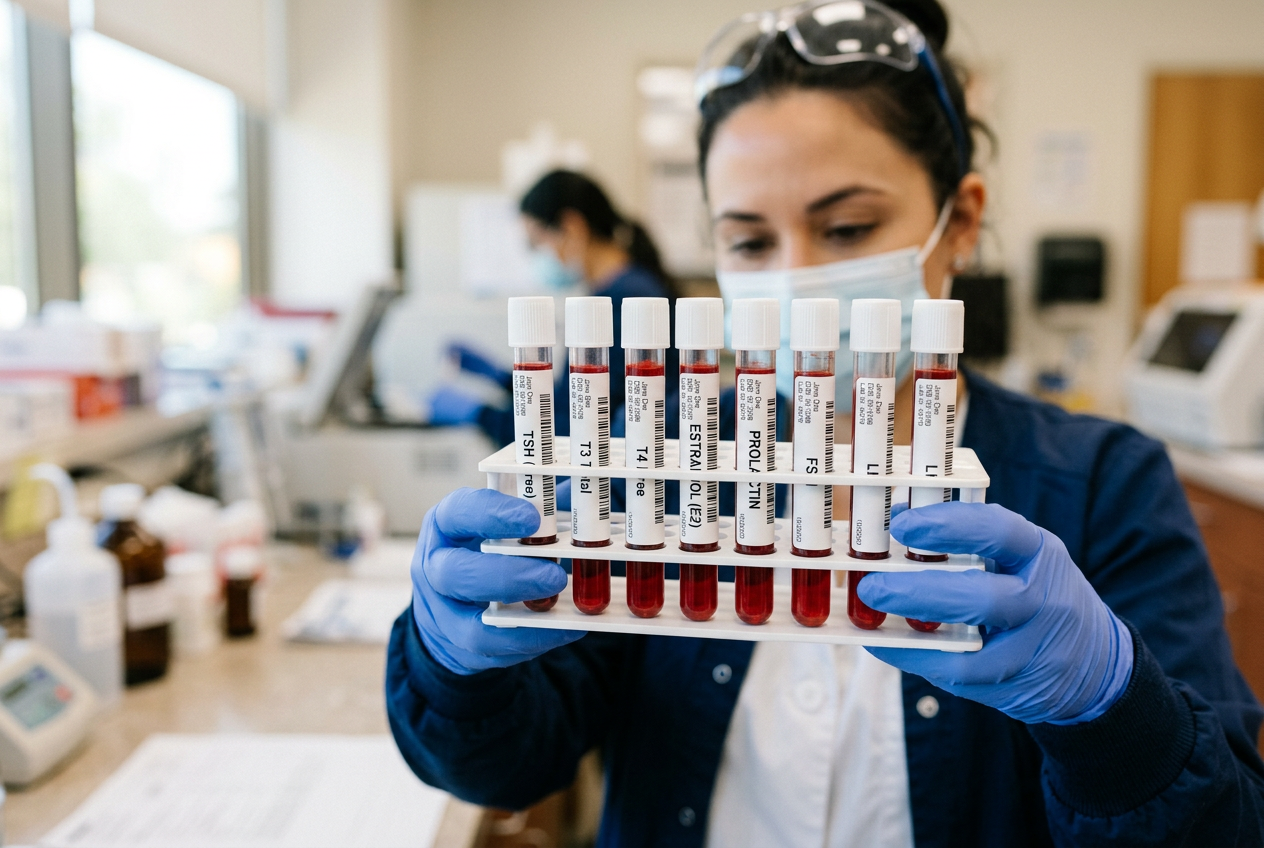
Standard thyroid panels measure TSH, and sometimes free T4. But estrogen affects how thyroid hormone binds and circulates. As estrogen fluctuates in perimenopause — sometimes surging, sometimes crashing within the same cycle — TSH can read borderline-high even when the thyroid itself is perfectly healthy. The clinician sees an out-of-range number, prescribes levothyroxine, and the patient gets neither relief nor an accurate diagnosis.
The Symptoms Both Conditions Share
Persistent Fatigue
The kind that doesn't lift after a full night's sleep. Both thyroid and perimenopause routinely cause it.
Brain Fog & Word-Finding
Estrogen receptors in the prefrontal cortex are dense. So are thyroid receptors. Both crashes look identical from the outside.
5–15 lb Gain Without Cause
Slowed metabolic rate is a feature of both. Distinguishing requires looking at where the weight lands, not just how much.
Scalp Thinning
Thyroid thins hair uniformly. Perimenopause thins it at the part and temples. The pattern matters.
The fastest way out of the diagnostic loop is to bring the right test list to the appointment. Most clinicians will run them — they just don't think to order them all at once.
What to Ask Your Doctor For

- ✓A full thyroid panel: TSH, free T3, free T4, reverse T3, and TPO antibodies — not just TSH.
- ✓FSH and estradiol drawn on day 3 of your cycle (if you still cycle predictably).
- ✓A morning cortisol (8am draw) to rule out the adrenal component that mimics both.
- ✓Fasting insulin and HbA1c — insulin resistance is the third condition that masquerades as both.
- ✓Iron panel including ferritin — low ferritin alone can produce every symptom on this list.
A Daily Protocol That Supports Both Thyroid and Hormonal Balance — Without Prescriptions
If your labs are caught in the diagnostic gray zone between thyroid and perimenopause, the right daily nutrients can support both systems simultaneously while you and your doctor sort out the full picture.

What's inside
- ✓Iodine and selenium to support healthy thyroid hormone conversion
- ✓Ashwagandha and maca to promote energy and healthy cortisol balance
- ✓Vitex and dong quai to support natural progesterone and estrogen rhythms
- ✓One scoop daily — designed for women navigating the thyroid-perimenopause overlap
Check Availability — Super Balance Drink Mix"My doctor was running circles between my thyroid and my hormones. While we waited for answers, I started this daily mix. Within six weeks my energy was back, my brain fog lifted, and I could finally think straight at work again."
Click above to check current availability
Risk-free for 60 days
90-Day Money-Back Guarantee — Try It Risk-Free
What Actually Helps Once You Know
If the answer is perimenopause, treatment options have evolved dramatically in the last five years. Transdermal estradiol with cyclic or continuous progesterone — properly dosed and properly monitored — resolves most symptoms within 8 to 12 weeks. If the answer is true thyroid dysfunction, the right medication and the right dose make a profound difference within four weeks. If the answer is both, sequencing matters: stabilize the thyroid first, reassess the perimenopausal picture six weeks later.